Things to Do in Carcassonne: A Complete Guide (2026)
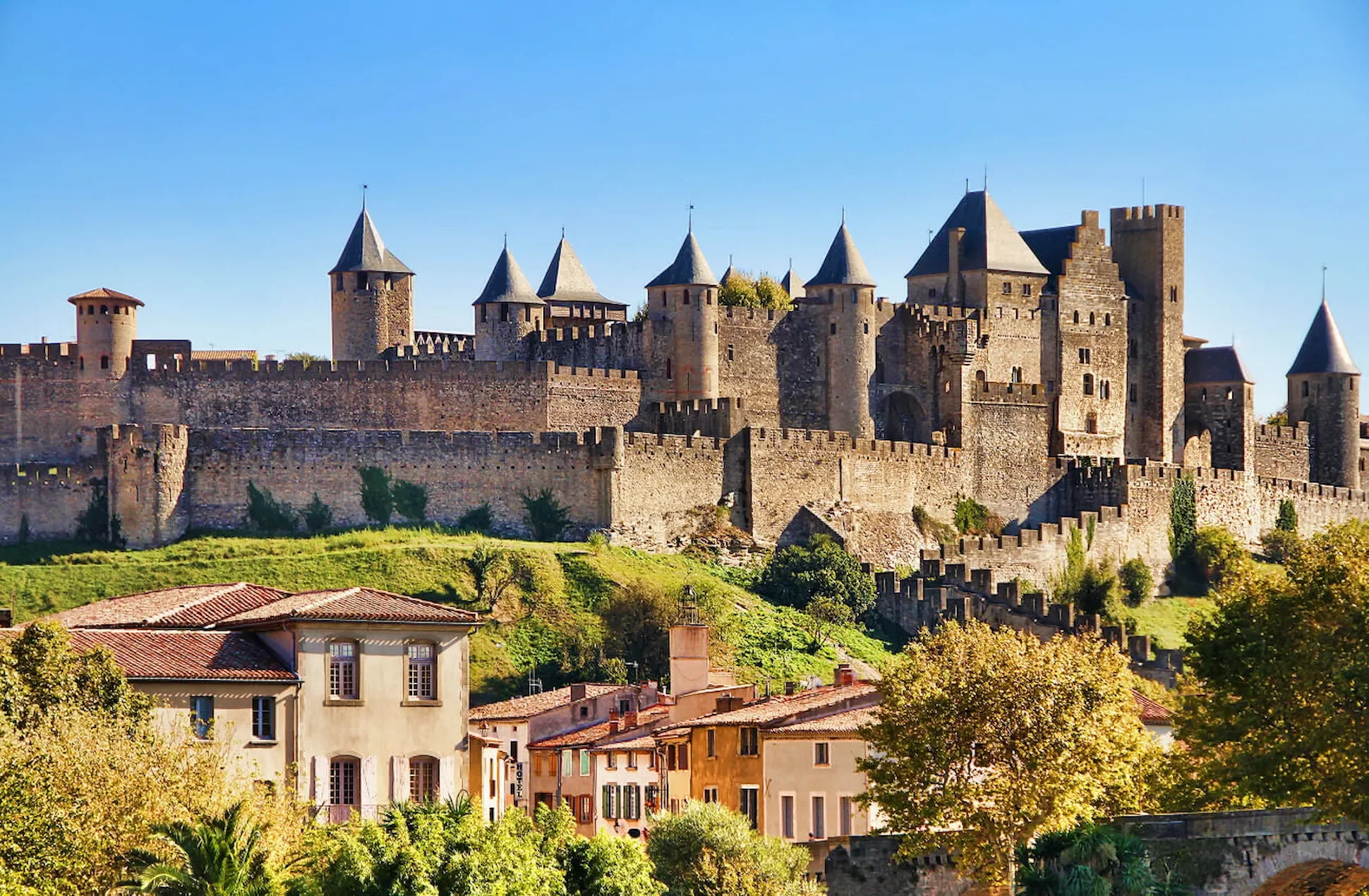
Carcassonne's headline attraction is its Cité Médiévale — the largest walled city in Europe, a UNESCO World Heritage Site since 1997 with 52 towers and 3 km of double ramparts. Beyond the fortress: the Canal du Midi, the Bastide Saint-Louis, Languedoc vineyards, and Cathar castles within easy reach.
This guide covers everything worth doing in and around Carcassonne — from the medieval cobblestones of the Cité to the vineyards of the Minervois, the covered market at Place Carnot, and the Cathar villages of the surrounding hills. Practical information — prices, opening hours, timing tips — is threaded throughout.
The Cité Médiévale — the must-see
There is no getting around it: the Cité Médiévale is one of the most extraordinary things you can see in France, and quite possibly in Europe. The UNESCO inscription came in 1997, recognising what has been called the finest example of a medieval fortified town on the continent — 52 towers, 3 km of double ramparts, and a hill-top silhouette that has barely changed in seven centuries.
The city owes much of its current appearance to the 19th-century architect Eugène Viollet-le-Duc, who undertook a sweeping — and occasionally controversial — restoration of the walls and towers from 1853 onwards. His critics accused him of romanticising the medieval fabric; his defenders point out that without the intervention, the whole thing would have been demolished. Either way, the result is dramatic.
The streets of the Cité are free to enter at any hour. The outer ramparts — the lower of the two rings of walls — can be walked for free, giving you a proper sense of the fortification's scale. What you pay for is entry to the Château Comtal and the inner rampart walk (more on that below).
Timing matters more here than almost anywhere else in France. By mid-morning in summer, tour groups from Toulouse, Barcelona, and Montpellier fill the narrow lanes, and the main drag — rue Cros-Mayrevieille — becomes a slow shuffle past ice-cream stalls and miniature-castle shops. Arrive before 9:00 or after 17:00 and the Cité becomes an entirely different place: quiet, golden in the late light, and genuinely atmospheric.
Château Comtal & the inner ramparts
The Château Comtal sits inside the Cité — a castle within a walled city, which rather neatly illustrates the layered defensive logic of medieval warfare. Built in the 12th century by the Viscounts of Carcassonne, it was subsequently reinforced by the French Crown after the Cathar crusade brought the city under royal control in the 13th century.
Admission includes access to the château's exhibition rooms and, crucially, the inner rampart walk — a circuit of the upper walls that gives you elevated views over both the Cité's rooftops and the Aude valley below. The guided tour (available in English) is worth the supplement if you want context; the self-guided option is fine if you prefer to move at your own pace.
Château Comtal — practical information
Admission: Adults €9.50 · Under-18s free · Guided tour +€5 · Family ticket €24
April – September: 10:00–18:30 (last entry 17:45)
October – March: 9:30–17:00 (last entry 16:15)
Closed: 1 January, 1 May, 25 December
Free entry: First Sunday of every month, November – March
Basilique Saint-Nazaire
Near the Porte d'Aude at the western end of the Cité, the Basilique Saint-Nazaire is one of the most undervisited buildings in Carcassonne — overlooked, perhaps, because it sits slightly off the main tourist circuit. That is a mistake. The basilica was begun in the 9th century and substantially rebuilt through the 11th to 14th centuries, meaning the nave is solidly Romanesque while the transepts are Gothic — a juxtaposition you can trace clearly as you walk through.
The stained glass in the Gothic transepts is magnificent, particularly the rose windows — some of the finest medieval glass in the Languedoc. Entry is free. Allow 30–45 minutes. Go when the light is coming in from the west, which means mid to late afternoon.
The Bastide Saint-Louis — the lower town
Most visitors to Carcassonne spend their entire stay inside the Cité Medieval and miss the Bastide Saint-Louis entirely. This is a shame, because the lower town — founded in the 13th century as a planned grid settlement on the west bank of the Aude — is where Carcassonne actually lives.
The central square, Place Carnot, is lined with plane trees, brasseries, and cafés where locals eat lunch and read the newspaper at a pace the Cité's tourist restaurants rarely match. The covered market on the square is one of the best in the Aude department. The streets around it have proper butchers, bakers, wine shops, and independent restaurants untouched by the souvenir-shop economy of the upper city.
If you are planning to eat well in Carcassonne, eat in the Bastide. If you are looking for where the city's residents actually spend their evenings, the Bastide is your answer. It takes about 20 minutes to walk from the Cité via the Pont Vieux.
Canal du Midi
Carcassonne has the distinction of sitting on not one but two UNESCO World Heritage Sites. The Canal du Midi — 240 km of man-made waterway linking the Atlantic at Bordeaux to the Mediterranean at Sète — was constructed in the 17th century under Louis XIV and remains one of the great engineering achievements of the pre-industrial era. Its inscription came in 1996, a year before the Cité's.
In Carcassonne, the canal runs through the lower town and is lined with the famous double rows of plane trees that shade the towpath in summer. Boat trips operate from the port near the Bastide — typically one to two hours, gentle and unhurried, taking you through one or two locks. It is an excellent antidote to a morning of cobblestones.
For the more active, the towpath is a superb cycling or walking route. The stretch east of Carcassonne towards Béziers is particularly beautiful: flat, shaded, lined with working locks and occasional canal-side restaurants. Bike hire is available near the port.
Pont Vieux
Built in the 14th century across the Aude, the Pont Vieux (Old Bridge) connects the Bastide Saint-Louis to the Cité. It is pedestrian-only and one of the most photogenic spots in Carcassonne. At dusk, when the floodlights illuminate the towers and ramparts of the Cité against the darkening sky, the view from the bridge is genuinely spectacular.
It is also simply a pleasant crossing — wide enough to stop and look, with the Aude running quietly below. Come here before dinner on your first evening. You will understand immediately why people return to Carcassonne.
Wine tasting in the Languedoc
Carcassonne sits at the centre of one of France's most diverse and undervalued wine regions. Within 20 to 30 minutes' drive, you are in the middle of four distinct AOC appellations: Minervois (to the north-east, garrigue-scented reds), Corbières (south-east, powerful and mineral), Cabardès (north-west, straddling Atlantic and Mediterranean climates in a way that produces genuinely unusual wines), and Malepère (west, lighter and more Atlantic in character).
Most small domaines in these appellations welcome walk-in visitors for tastings, particularly outside of August when the harvest period begins. A tasting is typically free or costs €3–5 for a small selection. The wines are excellent value by any standard — you will find bottles here that would cost twice as much with a better-known label.
If you are hiring a car for a day trip, the Minervois is perhaps the most rewarding circuit: head north on the D118, pick your way through the villages of Laure-Minervois or Rieux-Minervois, stop at two or three domaines, and return through the Montagne Noire foothills. It is a fine day.
The Carcassonne market
The market at Place Carnot in the Bastide Saint-Louis runs on Tuesday, Thursday, and Saturday mornings — the Saturday version being the largest and most atmospheric. It is one of the few places in Carcassonne that feels entirely disconnected from the tourist economy of the upper city.
Expect: Aude cheeses (notably the sheep's milk fromages from the Pyrénées foothills), black and green olives cured in a dozen different ways, bottles of Minervois and Corbières at domaine prices, fresh seasonal vegetables, charcuterie, and flower stalls. A few stalls sell textiles and housewares. Go between 8:30 and 11:00 for the best selection. Bring a bag.
Day trips from Carcassonne
The countryside around Carcassonne rewards those with a car. Three destinations stand out.
Lastours — the four Cathar castles (~20 minutes north)
Four ruined Cathar fortresses cling to a narrow rocky ridge above the gorge of the Orbiel, in the foothills of the Montagne Noire. The castles — Cabaret, Surdespine, Quertinheux, and the later Tour Régine — were never taken by force during the Cathar crusade; they eventually surrendered by negotiation. A viewpoint from the village below gives you the classic panorama of all four in a single frame; a steeper path climbs to the ruins themselves. It is one of the most dramatic landscapes in the Aude.
Lagrasse — one of France's most beautiful villages (~40 minutes)
Lagrasse is officially listed among Les Plus Beaux Villages de France and justifiably so. The village is centred on a magnificent Carolingian abbey — partly inhabited by monks, partly open to visitors — and crossed by twin humpback bridges over the Orbieu river. The medieval streets are intact, the atmosphere is unhurried, and there is almost none of the commercial gloss that afflicts more famous villages. Go on a weekday and you may have it largely to yourself.
Mediterranean beaches (~1 hour east)
The Mediterranean coast is an hour's drive along the A61 motorway. The two beaches closest to Carcassonne are Narbonne-Plage — wide, sandy, with all facilities, backed by a small resort town — and Gruissan, slightly more sheltered, built around a lagoon and an unusual circular medieval village on a hill. Either makes an excellent day out if you have been on cobblestones for two days and want to put your feet in the sea.
After all that walking — recover your legs
A full day in the Cité is typically 8 to 12 km of walking — on medieval cobblestones, uneven stone steps, and sloped rampart paths that were never designed with comfort in mind. Add a day trip to Lastours or a morning at the market, and by evening the cumulative fatigue in your legs is real. Swelling, heaviness, and the sensation of feet that have been on hard surfaces all day are entirely normal after a Carcassonne itinerary.
The Un Temps pour Elle cabinet is at 6 rue Fernand Léger, 10 minutes' walk from the Cité Medieval. It is an exclusively women-only space — no male clients, no male staff — which makes it particularly suited to solo female travellers or groups of women wanting to feel completely at ease.
Olena is a wellness massage practitioner who speaks English fluently alongside French, Russian, and Ukrainian. With 26 years of experience, she adapts each session to your comfort and preferred pressure. After a long day of sightseeing, the lymphatic-style wellness massage offers light, rhythmic movements and a calm pause for tired-feeling legs, without making medical claims about swelling or circulation.
| Duration | Best for | Price |
|---|---|---|
| 30 min | Quick reset between sightseeing | 40 € |
| 45 min | Focused work on one area | 50 € |
| 60 minPopular | Full treatment — most popular | 60 € |
| 90 min | Proper recovery session | 90 € |
| 180 min | Complete half-day wellness experience | 180 € |
All major cards accepted. Book by WhatsApp — Olena replies in English.
Practical tips
Getting there
Ryanair operates direct flights from London Stansted to Carcassonne airport (CCF) year-round, with a flight time of around two hours. Easyjet and British Airways serve Toulouse-Blagnac (TLS), an easy one-hour drive along the A61. Full details, including seasonal routes from Manchester and Edinburgh, in our Carcassonne from the UK guide.
How long to stay
Two days is the absolute minimum to see the Cité and the Bastide properly. Three days is ideal: it adds a day trip, a wine tasting, and a recovery session. One day is possible from a Toulouse base, but the Cité deserves more than a rushed afternoon.
Best time to visit
May–June and September hit the sweet spot: warm and dry, with manageable crowds and all attractions on full hours. July and August bring extreme heat (35–40 °C) and very large crowds in the Cité. October is pleasant and quiet but some attractions start reducing their hours.
Parking
There are paid car parks immediately outside the Cité gates (Parking Gambetta and Parking du Palais de Justice). Free residential street parking is available in the Bastide Saint-Louis — try the streets north of Place Carnot. Parking inside the Cité itself is restricted and not worth attempting in high season.
Frequently asked questions
- Is Carcassonne worth visiting?
- Absolutely. Carcassonne is one of the best-preserved medieval fortified cities in Europe and a UNESCO World Heritage Site since 1997. The combination of the Cité Médiévale, the Canal du Midi (a second UNESCO site), the surrounding Languedoc wine country, and the nearby Cathar castles makes it one of the most rewarding destinations in southern France.
- How many days do you need in Carcassonne?
- Two days is the minimum to see the Cité properly and explore the Bastide Saint-Louis. Three days is ideal: it gives you time for a wine tasting, a day trip to Lastours or Lagrasse, a walk along the Canal du Midi, and a recovery session before you leave. A single day is possible but rushed.
- Is the Cité de Carcassonne free?
- Walking the streets of the Cité and the outer ramparts is completely free. Entry to the Château Comtal and the inner rampart walk costs €9.50 for adults (free for under-18s). The Basilique Saint-Nazaire is also free. The first Sunday of every month from November to March, the château is free for everyone.
- What is Carcassonne famous for?
- Carcassonne is famous primarily for its Cité Médiévale — the largest walled city in Europe, with 52 towers and 3 km of double ramparts. It is also famous for the board game Carcassonne (named after the city), the cassoulet stew that originated in the region, and as a gateway to Cathar country and the Languedoc wine appellations.
- When is the best time to visit Carcassonne?
- May, June, and September are the sweet spot: the weather is warm and dry, the crowds are manageable, and most attractions are open on full summer hours. July and August are busy and very hot (35–40 °C is common), with queues at the château and the streets packed by midday. Spring and autumn offer the best balance of good weather and breathing room.
- Is Carcassonne good for a family trip?
- Yes — children tend to love the Cité Médiévale, the towers, and the rampart walls. Under-18s enter the Château Comtal free, and there is a family ticket (€24) available. The old city has plenty of places to eat, the cobblestone streets are manageable with older children, and the Canal du Midi offers a gentle boat trip for a change of pace. Pushchairs can be tricky on the uneven cobblestones inside the Cité.
Planning your trip to Carcassonne?
Book a recovery massage at Un Temps pour Elle before you fly home. Olena replies to WhatsApp messages in English, usually within a couple of hours.